Professor Jerry Brotton reveals that maps are far more than neutral guides to places: they are expressions of the societies that create them and powerful instruments for shaping territory, belief and authority. Beginning with some of the earliest known maps, he traces how cartography evolved from marking land and ownership to serving kings, empires, scientists and governments. From Henry VIII’s coastal surveys and the Cassini family’s scientific breakthroughs to the drawing of modern national borders, the series shows how maps can define who controls land, who belongs where and even how entire peoples understand the world around them. Across the three episodes, presented here together in a single uninterrupted video, the journey moves from ancient and medieval worldviews to imperial expansion and the digital age. Brotton explores religious maps, Aztec symbolism, Victorian attempts to classify societies, the politics behind projections of the globe, and the rise of Google Earth and data-driven mapping. He then follows the mapmakers and explorers who turned distant lands into targets for conquest and profit, from Ptolemy and Columbus to Walter Raleigh and the trading empires that followed. The story ends in the Arctic, where new maps are once again being used to stake claims over oil, gas and minerals, proving that even in the twenty-first century, cartography remains inseparable from power, plunder and possession.
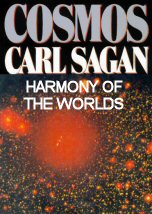
Beginning with the separation of the fuzzy thinking and pious fraud of astrology from the careful observations of astronomy, Sagan follows the development of astronomical observation. Beginning with constellations and ceremonial calendars (such as those of the Anasazi), the story moves to the debate between Earth and Sun-centered models: Ptolemy and the geocentric worldview, Copernicus' theory, the data-gathering of Tycho Brahe, and the achievements of Johannes Kepler (Kepler's laws of planetary motion and the first science-fiction novel).
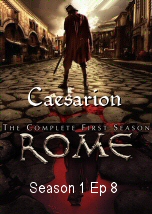
In Egypt, Caesar rebukes the advisers of the boy king, Ptolemy XIII, for their presumption in eliminating Pompey and demands the man who killed him. Caesar decides to intervene in the dispute between Ptolemy and his sister-wife, Cleopatra, to ensure both Rome's grain supply and his own access to Egypt's treasure. Antony, in an unusual show of prudence, advises against this with only half a legion in Alexandria and Cato and Scipio still at large in Africa. In Rome, Brutus gets a chilly reception from Servilia when he returns home from Greece.
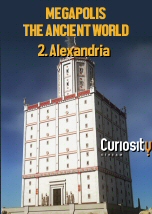
Feast your eyes on a reconstruction of the mega-city and its amazing buildings. Alexandria, built in the middle of rancid marshland, had become in less than a century, the greatest city of the Mediterranean. An ideal position at the crossroads of east and west, and one that brought her great riches. Huge, modern, gleaming white and cosmopolitan, like no other in antiquity, it created its own identity. While the beauty of its planning, its great arteries, its temples and its ports would be equalled only by its openness to the rest of the world. And the monumental achievements of its sovereigns, still shrouded in mystery, we'll never cease to fire our imagination for millennia to come.










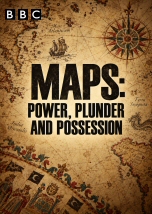


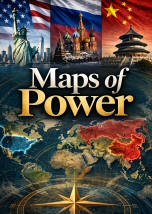
Across the three episodes, presented here together in a single uninterrupted video, the journey moves from ancient and medieval worldviews to imperial expansion and the digital age. Brotton explores religious maps, Aztec symbolism, Victorian attempts to classify societies, the politics behind projections of the globe, and the rise of Google Earth and data-driven mapping. He then follows the mapmakers and explorers who turned distant lands into targets for conquest and profit, from Ptolemy and Columbus to Walter Raleigh and the trading empires that followed. The story ends in the Arctic, where new maps are once again being used to stake claims over oil, gas and minerals, proving that even in the twenty-first century, cartography remains inseparable from power, plunder and possession.