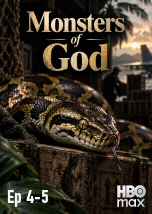
In the final two episodes of the series, the reptile trade enters a new and even more lucrative era. After prison, Tommy Crutchfield returns to find an industry transformed by the rise of genetically altered “morphs”, rare colour and pattern variations that can sell for enormous sums. What appears to be a more legitimate breeding business quickly collides again with illegal trafficking, as Operation Chameleon begins to expose the international network linking collectors, dealers and even major zoological institutions. The investigation then closes in on Anson Wong, the Malaysian trafficker described as one of the most powerful figures in the global reptile trade. As U.S. Fish and Wildlife agents work undercover to penetrate his organization, the story expands from rare snakes and lizards to critically endangered species such as the ploughshare tortoise, whose extraordinary black-market value has helped drive it toward extinction in the wild. These final episodes reveal how obsession, vast profits, corruption and international demand can turn the pursuit of exotic animals into a criminal empire with devastating consequences for wildlife.
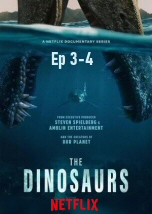
In the final two episodes of the series, produced by Steven Spielberg and narrated by Morgan Freeman, the Age of Dinosaurs reaches its most spectacular and dangerous chapter. After a harsh freeze reshapes life on Earth, the Cretaceous world emerges with rising seas, scattered islands and new hunting grounds where giant reptiles thrive. Pterosaurs glide across the skies searching for food while powerful predators patrol land and ocean in a planet completely ruled by dinosaurs. Among these rulers stands the most formidable hunter of all — Tyrannosaurus rex. Yet while these giants dominate the Earth, the planet itself is slowly changing. Continents drift apart, ecosystems evolve and an unseen threat begins its silent journey through space, foreshadowing the catastrophic event that will one day end the age of dinosaurs.
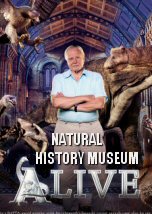
In this ground-breaking film, Sir David Attenborough takes us on a journey through the world-famous Natural History Museum in London in a captivating tale of discovery, adventure, and magic, where state-of-the-art CGI, science, and research combine to bring the museum's now long-extinct inhabitants to life to discover how these animals once roamed the planet. As the doors are locked and night falls, Attenborough stays behind and meets some of the most fascinating extinct creatures which come alive in front of his eyes; dinosaurs, ice age beasts, and giant reptiles. The film fulfils a lifelong dream of him, who said: 'I have been coming to the Natural History Museum since I was a boy. It's one of the great places to come to learn about natural history. In this film we have the technology to bring back to life some of the most romantic and extraordinary extinct creatures that can be conceived; some are relatively recent animals like the dodo, others older like the dinosaurs, and some we only know through fossil evidence. Using our current scientific knowledge, this film brings these creatures alive, allowing me to look at some of the biggest questions surrounding them.'
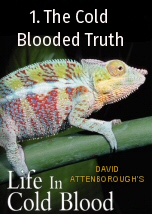
David Attenborough reveals the surprising truth about the cold-blooded lives of reptiles and amphibians. These animals are as dramatic in combat, as colourful in their communication and as tender in their parental care as any other animals. Join giant courting crocodiles, jousting tortoises and bright red sumo-wrestling frogs in their sophisticated, solar-powered lives.
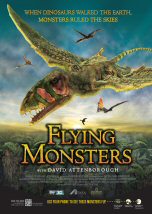
For thousands of years, humans have believed that there were once flying monsters. But did they really exist beyond our nightmares? 220 million years ago dinosaurs were beginning their domination of Earth. But another group of reptiles was about to make an extraordinary leap: pterosaurs were taking control of the skies. The story of how and why these mysterious creatures took to the air is more fantastical than any fiction. In Flying Monsters 3D, David Attenborough the worlds leading naturalist, sets out to uncover the truth about the enigmatic pterosaurs, whose wingspans of up to 40 feet were equal to that of a modern day jet plane. Attenborough works with scientists to understand the incredible story of the evolution of the pterosaurs, a story that unfolds in such stunning locations as New Mexico, the Jurassic Coast of Lyme Regis in Britain, an ancient pterosaur landing site in Southern France and a fossil pit in Germany where near perfect pterosaur specimens have been found. The central question and one of the greatest mysteries in palaeontology is: how and why did pterosaurs fly? How did lizards the size of giraffes defy gravity and soar through prehistoric skies? Driven by the information he finds as he attempts to answer these questions, Attenborough starts to unravel one of sciences more enduring mysteries, discovering that the marvel of pterosaur flight has evolutionary echoes that resonate even today. Flying Monsters 3D is a groundbreaking film that uses cutting-edge 3D technology and CGI to bring the story of giant flying monsters and their prehistoric world to life. Audiences of all ages will be in awe as they enter the world and experience, as never before, REAL Flying Monsters in 3D.
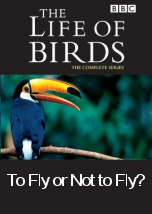
The first episode looks at how birds first took to the skies in the wake of the insects. It begins in Mexico, where Sir Attenborough observes bats being outmanoeuvred by a red-tailed hawk. Pterosaurs were the birds' forerunners, some 150 million years after dragonflies developed the means of flight, but eventually went extinct together with the dinosaurs. Birds had by then already evolved from early forms like archaeopteryx, the first creature to possess feathers. Its ancestry can be traced through reptiles, and some current species, such as the flying lizard, possibly show paths this evolution may have taken." One of the biggest birds to have ever existed was the terror bird, which proliferated after dinosaurs vanished and stood up to 2.5 metres tall. By comparison, the ostrich, while not closely related, is the largest and heaviest living bird. It was probably the evasion of predators that drove most birds into the air, so their flightless cousins evolved because they had few enemies. Accordingly, such species are more likely to be found on islands, and Sir Attenborough visits New Zealand to observe its great variety, most especially the kiwi. Also depicted is the moa, another huge creature that is now gone. The takahē is extremely rare, and high in the mountains of New Zealand, Sir Attenborough discovers one from a population of only 40 pairs. Finally, another example on the brink of extinction is the kakapo, which at one point numbered only 61 individuals. A male is heard calling — an immensely amplified deep note that can be heard at great distances from its nest.




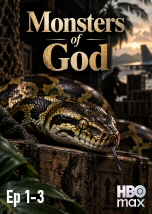






The investigation then closes in on Anson Wong, the Malaysian trafficker described as one of the most powerful figures in the global reptile trade. As U.S. Fish and Wildlife agents work undercover to penetrate his organization, the story expands from rare snakes and lizards to critically endangered species such as the ploughshare tortoise, whose extraordinary black-market value has helped drive it toward extinction in the wild. These final episodes reveal how obsession, vast profits, corruption and international demand can turn the pursuit of exotic animals into a criminal empire with devastating consequences for wildlife.