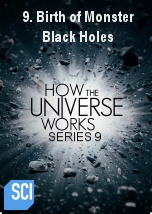
Professor Brian Cox joins Chris Lintott and the team to investigate one of the most intriguing new mysteries in modern astronomy. Observations from the James Webb Space Telescope have revealed hundreds of compact, extraordinarily bright objects known as “little red dots”, appearing less than a billion years after the Big Bang. Many may hide rapidly growing supermassive black holes, raising a profound question: how could such enormous objects have formed so early in cosmic history? The journey begins with the strange physics of black holes themselves, from event horizons and singularities to the supermassive black hole at the centre of the Milky Way and the gigantic black hole in the galaxy M87. With cosmologist Emma Chapman and Professor Sadegh Khochfar, the programme explores radical explanations for these ancient monsters, including primordial black holes born soon after the Big Bang and massive black holes formed directly from collapsing clouds of gas, bypassing stars altogether. Cutting-edge computer simulations recreate the first billion years of the universe and reveal how the earliest galaxies and black holes may have emerged within the cosmic web. These discoveries are forcing astronomers to reconsider not only how supermassive black holes grow, but how galaxies and the early universe itself evolved.
The collision of two supermassive black holes is the most violent event that can occur in the universe; experts explore where a black hole's energy originates and what really happens when the two most powerful objects in the cosmos clash. It is a soul-chilling, mind-crushing amount of energy. Take your ringside seat to the ultimate fight of the universe. Get ready for the final of the cosmos heavyweight championship.
Recently, the Event Horizon Telescope project captured the first image ever of a black hole. Now, new discoveries might finally reveal how supermassive black holes are made, and using the latest technology, experts are on the verge of understanding how these monsters grow and how they affect life on our planet. Supermassive black holes: Gargantuan monsters that lurk at the center of galaxies. Right now you are travelling at half a million miles an hour around a giant black hole four million times the mass of the sun. But there's a mystery about these colossal beasts. We have no idea where they came from. How did they get so big so quickly?
The black hole at the centre of the Milky Way is getting ready to feast. A gas cloud three times the size of our planet has strayed within the gravitational reach of our nearest supermassive black hole. And across the globe, telescopes are being trained on the heart of our Milky Way galaxy, some 27,000 light years from Earth, in the expectation of observing this unique cosmic spectacle. For cosmic detectives across the Earth, it is a unique opportunity. For the first time in the history of science, they hope to observe in action the awesome spectacle of a feeding supermassive black hole.
Supermassive black holes are the engines that power our universe and one of the major players in the evolution of galaxies. They're in fact the driving force at the heart of nearly every galaxy in the cosmos. Now, a new mystery has emerged about the oldest supermassive black holes. We see supermassive black holes in the very early universe. And we don't understand how they grew so large so quickly. We have clues about their formation but, can we solve the mystery of this supermassive growth spurt?
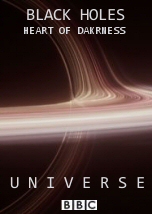
The centre of our galaxy is home to an invisible monster of unimaginable power – a supermassive black hole named Sagittarius A star, with four million times the mass of the Sun. Recent astronomical breakthroughs have confirmed not only that black holes like Sagittarius A star exist, but that these bizarre invisible objects may be the ultimate galactic protagonists. Stunning CGI takes us back to witness the fiery origins of our galaxy’s black hole 13.6 billion years ago, when the early universe was home to colossal blue stars, and when they ran out of fuel, they collapsed under their own enormous mass, crushing down into an object so small and so dense it punched a hole in the fabric of the universe. Over billions of years, Sagittarius A star feasted on nearby gas, stars, and through cataclysmic mergers with other black holes. A breakthrough discovery by Nasa’s Fermi gamma-ray telescope has shown that our black hole had the power to sculpt the entire galaxy, creating vast bubbles of gas above and below our galaxy and even protecting stars systems as ours. In a mind-bending conclusion, Brian Cox reveals how our modern understanding of black holes is challenging our concepts of reality to the breaking point. In trying to understand the fate of objects that fall into Sagittarius A star, scientists have come to a stunning conclusion: space and time, concepts so foundational to how we experience the world around us, are not as fundamental as we once thought.




















With cosmologist Emma Chapman and Professor Sadegh Khochfar, the programme explores radical explanations for these ancient monsters, including primordial black holes born soon after the Big Bang and massive black holes formed directly from collapsing clouds of gas, bypassing stars altogether. Cutting-edge computer simulations recreate the first billion years of the universe and reveal how the earliest galaxies and black holes may have emerged within the cosmic web. These discoveries are forcing astronomers to reconsider not only how supermassive black holes grow, but how galaxies and the early universe itself evolved.