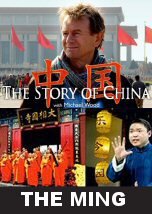




The tale of one of China's most famous dynasties begins with the amazing story of Hongwu, a peasant rebel who founded one of greatest eras in Chinese history. The film takes us to his great capital Nanjing, with its 21 miles of walls, each brick stamped with the name of the village that made it. Following the trail, we go to the Bao family village and see the villagers act a Ming murder story. Like many authoritarian states, the Ming were obsessive about architecture. We see the giant fortifications of the Great Wall, the ritual enclaves of the Forbidden City in Beijing and travel with bargeman Mr Hu down the Grand Canal, China's great artery of commerce right up to the present day. We then hear about Admiral Zheng He's voyages to Africa and the Gulf decades before Columbus, watch the construction of an ocean-going wooden boat 250ft long, and hitch a ride on a replica Ming junk in the South China Sea. As state prosperity grew, so did a rising middle class. Wood looks at Ming culture in Suzhou, the 'Venice of China'. Staying in a merchant's house, he discovers the silk, ceramic and lacquer-making industries, and visits one of the most beautiful gardens in the city. Then on to Macao and the arrival of Jesuit missionary Matteo Ricci, who hoped to convert China to Christianity. In the cathedral in Beijing, we learn more about these fateful exchanges with the west. Finally in Shaoxing, we visit the house of the 'Ming Proust' and at grassroots the Zhao family in Fujian where the film ends in an elegiac mood with the fall of the Ming in 1644.
The ultimate adventure in scientific inquiry, this fascinating program follows the exploits of a small group of pioneering mathematicians who discovered a whole area of study that is revolutionizing all branches of understanding in the world: fractal geometry. Fractals are most recognized as a series of circular shapes with a border surrounded by jagged "tail-like" objects. The program, aimed at the average viewer does a fine job of explaining the background of fractals, first by beginning with the story of Pixar co-founder, Loren Carpenter's work at Boeing, developing 3D terrain from scratch using fractals. From there the program starts at the beginning with an introduction to Benoit Mandelbrot and his revolutionary work. The explanations are full of solid factual information but never talk above the level of a viewer who has some understanding of basic mathematical principles. Once the concept is presented the program spends the rest of the time showing how prevalent the fractal is in life. For a program about a mathematical concept, "Fractals" is very engaging, showing how the process was applied to special effects as far back as the Genesis planet from "Star Trek II" all the way to the spectacular finale on Mustafar in "Star Wars: Episode III." I found myself astonished at how fractals were the source of the lava in constant motion and action during the Obi-Wan/Anakin fight. What is more amazing is when the program delves into practical applications such as cell phone antennas, and eventually the human body. For the average person who enjoys watching science related programs, even on a sporadic basis, "Fractals" will prove to be a very worthwhile experience. The program is well produced, integrating talking head interviews (including some with Mandelbrot himself) with standard "in the field" footage. The structure of the program is very logical and never finds itself jumping around without direction. In simplest terms, this is a program as elegant as the designs it focuses on.
An astonishing close encounter with some of the most exotic creatures inhabiting the hidden depths. In the realm of the giant octopus, the rainbow nudibranch (sea slug), and the Scorpion fish, viewers become a fearless undersea explorers, discovering the strange and unusual partnerships these 'star wars' creatures forge to ensure their survival, and learning how this cooperation allows life in this enchanting world to flourish. Filmmaker Howard Hall guides an astonishing adventure. Johnny Depp and Kate Winslet narrate as Green Sea Turtles gather so Surgeonfish can strip harmful algae from their shells. A Humboldt Squid changes color four times per second like a flashing strobe light. A Mantis Shrimp’s claws have the speed of a bullet in battling a hungry octopus. Brace yourself to be submerged in a wondrous new dimension.
Professor Jim Al-Khalili investigates one of the most important concepts in the world today - information. He discovers how we harnessed the power of symbols, everything from the first alphabet to the electric telegraph through to the modern digital age. But on this journey he learns that information isn't just about human communication, it's woven very profoundly into the fabric of reality.
Idolized in ancient Norse mythology as the protector god, Thor battles evil ogres and a giant serpent bent on destroying mankind. It's the quintessential fight for survival that culminates in a final showdown between good and evil. But was the rise and fall of the hero Thor ancient code for something greater? Today, new discoveries unlock the hidden truth behind the Norse god of Thunder. Able to wield thunder from his hammer, Thor was the most revered of the Norse gods, from fending humanity from the giants that brought calamity, to his pursuit of the Midgard Serpent. Though, his fate is told to sealed during Ragnarok, it is actually the invasion of Christianity that proves far more damning to this mighty god.
From director Amy Berg: 'Just a year and a half ago, after spending over four years on the same story for CNN and CBS before that, a paedophile priest named Oliver O'Grady decided he would participate in the film I wanted to make. It became Deliver Us From Evil -- the story from inside the sickest mind possible, the secrets that were meant to stay in the private files and crypts of the Roman Catholic Church, and the blind trust in those they perceived as God's messengers that left families with no faith and children with no innocence. After filming for a week and a half, the then defrocked priest mentioned he might need to move to Canada after this film comes public. Seeing the pain, corruption and missed opportunities to provide ministry to those in need was truly a tragic story to watch and the loss was more devastating than I ever imagined. It was so difficult to be so close to such a horror story that in the priest's words "never should have happened.".
Like many authoritarian states, the Ming were obsessive about architecture. We see the giant fortifications of the Great Wall, the ritual enclaves of the Forbidden City in Beijing and travel with bargeman Mr Hu down the Grand Canal, China's great artery of commerce right up to the present day. We then hear about Admiral Zheng He's voyages to Africa and the Gulf decades before Columbus, watch the construction of an ocean-going wooden boat 250ft long, and hitch a ride on a replica Ming junk in the South China Sea.
As state prosperity grew, so did a rising middle class. Wood looks at Ming culture in Suzhou, the 'Venice of China'. Staying in a merchant's house, he discovers the silk, ceramic and lacquer-making industries, and visits one of the most beautiful gardens in the city. Then on to Macao and the arrival of Jesuit missionary Matteo Ricci, who hoped to convert China to Christianity. In the cathedral in Beijing, we learn more about these fateful exchanges with the west. Finally in Shaoxing, we visit the house of the 'Ming Proust' and at grassroots the Zhao family in Fujian where the film ends in an elegiac mood with the fall of the Ming in 1644.