










Last Watched

"Grassland"  Sort by

The Americas Ep 1-3

   2026    Nature    HD
Across two continents and from one pole to the other, this spectacular wildlife series explores the wonders, mysteries and fragilities of the Americas. Narrated by Tom Hanks, it reveals extraordinary animal behaviour, dramatic struggles for survival and some of the planet’s most varied landscapes, from frozen wilderness and ancient forests to deserts, tropical seas and vast grasslands. Filmed over five years and more than 180 expeditions, the series combines intimate wildlife stories with remarkable natural spectacles, showing both the resilience of life and the delicate balance on which these ecosystems depend.
In the first three episodes, the journey begins along the Atlantic Coast, where wild horses battle, bald eagles pursue ospreys, sharks move among great shoals of fish, raccoons adapt to city life and black bears search ancient forests for food. It then heads south into Mexico, where deserts meet the tropics and pygmy owls, hunting orcas, orchid bees and mysterious creatures in flooded caves reveal a hidden world of astonishing diversity. Finally, the Wild West brings an even harsher test of survival, as coyotes face a snowbound Yellowstone, hundreds of rattlesnakes emerge from their winter refuges, woodpeckers compete to store food, bison clash across the Great Plains and immense gatherings of cranes continue one of nature’s most ancient migrations.
Series: The Americas

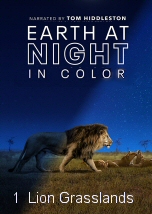
Lion Grasslands

   2020    Nature
Filmed across six continents, this docuseries uses cutting-edge camera technology to capture animal's nocturnal lives revealing new behaviours filmed in full color like never before. In the first episode, we will see how after dark on Kenya's Maasai Mara grasslands, a lioness won't rest until she finds the young cubs she's lost.
Series: Earth at Night in Color
The Great Flood

   2009    Nature
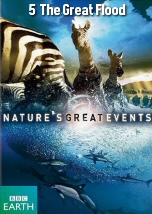
The great flood in the Okavango turns 4,000 square miles of arid plains into a beautiful wetland. Elephant mothers guide their families on an epic trek across the harsh Kalahari Desert towards it, siphoning fresh water from stagnant pools and facing hungry lions. Hippos battle for territory, as the magical water draws in thousands of buffalo and birds, and vast clouds of dragonflies. Will the young elephant calves survive to reach this grassland paradise? The experienced mother elephants time their arrival at the delta to coincide with the lush grass produced by the great flood.
In a TV first, the programme shows the way they use their trunks to siphon clean water from the surface layers of a stagnant pool, while avoiding stirring up the muddy sediment on the bottom with their feet. Lechwe swamp deer, zebras, giraffes, crocodiles and numerous fish and thousands of birds arrive in the delta. And, in a phenomenon never before filmed in the Okavango, thousands of dragonflies appear - seemingly from nowhere - within minutes of the flood arrival, mating and laying eggs. As the flood finally reaches its peak, elephants and buffalo, near the end of their epic trek across the desert, face the final gauntlet of a hungry pride of lions. In a heart-wrenching sequence, a baby elephant is brought down by a lion in broad daylight.
Series: Nature Great Events

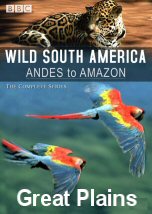
Great Plain

   2005    Nature
This edition explores the vast grasslands of the continent, hauntingly beautiful regions inhabited by strange creatures - giant anteaters, armadillos, maned wolves, capybara and jaguars.
Series: Wild South America

The Grasslands

   2011    Culture
Grasslands feed the world. Over thousands of years, we humans have learned to grow grains on the grasslands and domesticate the creatures that live there. Our success has propelled our population to almost seven billion people. But this episode reveals that, even today, life in the 'Garden of Eden' isn't always rosy. We walk with the Dorobo people of Kenya as they bravely attempt to scare off a pride of hungry lions from their freshly caught kill. We gallop across the Steppe with extraordinary Mongolian horsemen who were 'born in the saddle'. And in a perfect partnership with nature built up over generations Maasai children must literally talk to the birds! The honeyguide leads them to find sweet treats, but they'll have to repay the favour.
Series: Human Planet

Birth of Humanity

   2010    History
We will nvestigate the first skeleton that really looks like us –Turkana Boy– an astonishingly complete specimen of Homo erectus found by the famous Leakey team in Kenya. These early humans are thought to have developed key innovations that helped them thrive, including hunting large prey, the use of fire, and extensive social bonds. The program examines an intriguing theory that long-distance running –our ability to jog– was crucial for the survival of these early hominids. Not only did running help them escape from vicious predators roaming the grasslands, but it also gave them a unique hunting strategy: chasing down prey animals such as deer and antelope to the point of exhaustion. Birth of Humanity also probes how, why, and when humans' uniquely long period of childhood and parenting began.
Series: Becoming Human
Blood of the Vikings

Blood of the Vikings

2001  History
All or Nothing: Arsenal

All or Nothing: Arsenal

2022  Culture
Space Deepest Secrets

Space Deepest Secrets

2020  Science
The Story of China

The Story of China

2016  History
Space Race

Space Race

2005  Technology
The Mind of a Chef

The Mind of a Chef

2017  Culture
Leaving Neverland

Leaving Neverland

2019  Culture
Top Gear

Top Gear

2012  Technology