




Last Watched

"Reptile"  Sort by

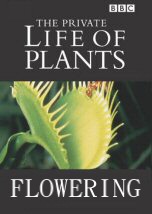
Flowering

   1995    Nature
The third episode is devoted to the ways in which plants reproduce. Pollen and a stigma are the two components needed for fertilisation. Most plants carry both these within their flowers and rely on animals to transport the pollen from one to the stigma of another. To do this, they attract their couriers with colour, scent and nectar. It isn't just birds that help pollination: some mammals and reptiles also do so. However, it is mostly insects that are recruited to carry out the task. To ensure that pollen is not wasted by being delivered to the wrong flower, some species of plant have developed exclusive relationships with their visitors, and the gentian and its attendant carpenter bees is one example. Since pollen can be expensive to produce in terms of calories, some plants, such as orchids, ration it by means of pollinia and a strategically placed landing platform. Other orchids offer no reward for pollination, but instead mislead their guests by mimicking their markings and aroma, thus enticing males to 'mate' with them (Pseudocopulation). The most extreme fertilisation method is one of imprisonment, and one plant that uses it is the dead horse arum. It is often found near gull colonies, and mimics the appearance and smell of rotting flesh. Blow-flies are attracted to it, and are forced to stay the night before being allowed to depart in the morning, laden with pollen. Finally, Attenborough introduces the world's largest inflorescence: that of the titan arum.
Series: The Private Life of Plants
Dragons of the Dry

   2008    Nature
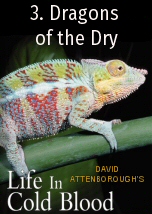
About 340 million years ago a brand new family of animals was evolving in the primeval swamps. They were to go one step further than the amphibians who had emerged onto dry and before them. For they would eventually completely cut their ties with water. They were the ancestors of todays lizards. They evolved scaly impermeable skins and moved up into the forests. They diversified into a multitude of different shapes and sizes. They developed signalling systems to communicate with one another. And they squabbled as animals do. For food they hunted insects that were already well established on the land in great numbers. And here without returning to water they produced their families. They powered their bodies not only with food but with the heat that they drew directly from the sun.
As they diversified so they spread into the harshest of the lands habitats. The baking waterless deserts which eventually they would come to dominate. Discover jacky lizards that wave, wrestling beaded lizards and the the world's smallest chameleon, which is no bigger than his thumbnail, and the biggest lizard in Australia.
Series: Life In Cold Blood

Rivals

   2015    Science    3D    HD
David Attenborough continues his search for the origins of flying animals, as he charts the rise of new, larger creatures – extinct reptiles that flew on wings of skin, dinosaurs that sprouted feathers to become the ancestors of birds, and gliding mammals that emerged from a life in the trees to dominate the night as bats. His journey spans the globe – from the rainforests of Borneo to see bizarre gliding animals, to China and its new discoveries of dinosaur fossils. Stunning CGI brings to life creatures that disappeared over 200 million years ago, and new filming techniques bring us closer than ever to the secrets of flight itself.
Series: Conquest of the Skies

Sophisticated Serpents

   2008    Nature
David Attenborough reveals the fascinating lives of snakes, the most misunderstood group of reptiles. A CCTV stakeout of wild rattlesnakes hunting shows, for the first time, what sophisticated predators they truly are. Attenborough is also on the receiving end of a spitting cobra's chemical weapons system, while the surprisingly beautiful and tender side of snakes is displayed in the sinuous courtship of kingsnakes, and the water birth of 15 beautiful yellow anaconda babies.
Series: Life In Cold Blood

Armoured Giants

   2007    Nature
The world of the armoured creatures is equally fascinating and bizarre. Galapagos giant tortoises solve the problem of making love in a suit of armour; a heated sea turtle orgy leaves females in mortal danger and we witness the explosive arrival of a baby pig-nosed turtle. Giant salt-water crocodiles crowd a flooded river-run to fish for mullet and a caiman leads her brood in a touching trek to a communal crèche.
Series: Life In Cold Blood

The Rules of Life

   2023    Science
The series ‘Life on Our Planet’ brought to life by Steven Spielberg and narrated by Morgan Freeman, unfolds the remarkable and epic four-billion-year journey of life on Earth. Its captivating narrative explores the continuous battle of life to conquer and survive, delving into the history of the 20 million species that exist today. However, what we witness is merely a snapshot in time; 99% of Earth's inhabitants are buried in our deep past. This series weaves the tales of these dynasties, chronicling their rise and fall in a story that is as incredible as it is enlightening, sparking a profound interest in the history and resilience of life on Earth.
The first episode traces the evolution of life on our planet and highlights the diversity of life, from ancient sharks to the reign of dinosaurs and the emergence of mammals. The episode showcases the constant struggle for survival and adaptation across different eras, illustrating the dynamic and often brutal nature of Earth's evolution.
Series: Life on Our Planet
Clarkson Farm Season 2

Clarkson Farm Season 2

2023  Nature
Untold

Untold

2021  Culture
The Lost Pirate Kingdom

The Lost Pirate Kingdom

2021  History
Modern Masters

Modern Masters

2024  Art
Coldplay Live

Coldplay Live

2012  Art
The Sky at Night

The Sky at Night

2026  Science