




Last Watched

"Roman Empire"  Sort by

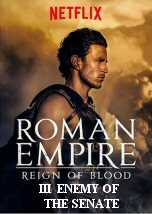
Enemy of the Senate

   2016    History
In the third episode of the series, Commodus rises to power as Rome's new emperor, but not everyone supports his ascent. Among those conspiring against him: his older sister Lucilla.
Series: Roman Empire: Reign of Blood
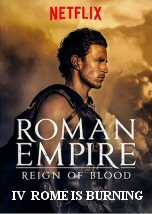
Rome is Burning

   2016    History
In the fourth episode of the series, Commodus defeats his sister's coup but withdraws from governing, allowing others to amass power while he engages in an affair and banishes his wife.
Series: Roman Empire: Reign of Blood
Fight for Glory

   2016    History
In the fifth episode of the series, lavish imperial games at the Colosseum are highlighted by the emperor's bloody victories, but his paranoid abuses of power lead to a final betrayal.
Series: Roman Empire: Reign of Blood
14 Days of Blood

   2016    History
In the last episode of the series, lavish imperial games at the Colosseum are highlighted by the emperor's bloody victories, but his paranoid abuses of power lead to a final betrayal.
Series: Roman Empire: Reign of Blood
Orthodoxy From Empire to Empire

   2011    Culture
In the third part of his journey into the history of Christianity, Professor Diarmaid MacCulloch charts Orthodoxy's extraordinary fight for survival. After its glory days in the eastern Roman Empire, it stood right in the path of Muslim expansion, suffered betrayal by crusading Catholics, was seized by the Russian tsars and faced near-extinction under Soviet communism. MacCulloch visits the greatest collection of early icons in the Sinai desert, a surviving relic of the iconoclastic crisis in Istanbul and Ivan the Terrible's cathedral in Moscow to discover the secret of Orthodoxy's endurance.
Series: A History of Christianity

Words on a Page

   2020    History
Writing itself is 5,000 years old, and for most of that time words were written by hand using a variety of tools. The Romans were able to run an empire thanks to documents written on papyrus. Scroll books could be made quite cheaply and, as a result, ancient Rome had a thriving written culture. With the fall of the Roman Empire, papyrus became more difficult to obtain. Europeans were forced to turn to a much more expensive surface on which to write: Parchment. Medieval handwritten books could cost as much as a house, they also represent a limitation on literacy and scholarship.
No such limitations were felt in China, where paper had been invented in the second century. Paper was the foundation of Chinese culture and power, and for centuries how to make it was kept secret. When the secret was out, paper mills soon sprang up across central Asia. The result was an intellectual flourishing known as the Islamic Golden Age. Muslim scholars made discoveries in biology, geology, astronomy and mathematics. By contrast, Europe was an intellectual backwater.
That changed with Gutenberg’s development of movable type printing. The letters of the Latin alphabet have very simple block-like shapes, which made it relatively simple to turn them into type pieces. When printers tried to use movable type to print Arabic texts, they found themselves hampered by the cursive nature of Arabic writing. The success of movable type printing in Europe led to a thousand-fold increase in the availability of information, which produced an explosion of ideas that led directly to the European Scientific Revolution and the Industrial Revolution that followed.
Series: The Secret History of Writing
Long Way Home

Long Way Home

2025  Culture
Coldplay Live

Coldplay Live

2012  Art
Monsters of God

Monsters of God

2026  Culture
Food Inc

Food Inc

2009  Technology
Becoming Human

Becoming Human

2010  History
Natural World

Natural World

2015  Nature