








Last Watched

"Water"  Sort by

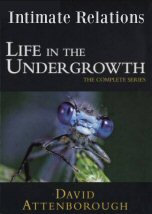
Intimate Relations

   2005    Nature
The world of invertebrates exists in a web of relationships with plants and other animals. Unique footage of the world's smallest insect (a fairy wasp only quarter of a millimetre long) shows it flying underwater to find the eggs of water beetles in which to lay its own brood. Some ants 'farm' the trees that give them shelter, creating areas known as 'Devil's gardens'. To make sure these grow without competition, they kill off other seedlings in the surrounding vegetation. The blister beetle's larvae huddle together on the end of a piece of grass and mimic a female bee. When a male bee tries to mate with the 'female', the larvae grab on to his belly. Confused, he flies away and searches for a real female. When he eventually finds her and mates with her, the beetle larvae hurriedly swap from his front on to her back, and hence get carried back to her nest where they eat her pollen supplies.
Series: Life in the Undergrowth
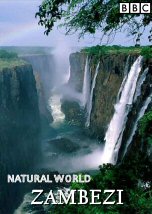
Zambezi

   2011    Nature
Africa's wildest river is home to the most spectacular wildlife. Hippos fight for territory while herds of elephant, water buffalo and zebra depend on it for life. In the wet season the rains burst the riverbanks and everyone, including people, must move whilst fish swim through the villages. In the dry season the creatures fight over the few pools of water while predators prowl. At its heart it plunges over Victoria Falls and into wild ravines before draining into the Indian Ocean, where storm clouds cycle the water back into the heart of Africa.
Series: Natural World

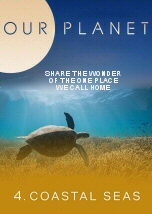
Coastal Seas

   2019    Nature    HD
Immense shoals of fish throng our shallow seas. Small fish, in turn, sustain bigger ones. The rich coastal seas are the fishing grounds of our planet and can provide an abundance of food for wildlife and humanity. The seas fringing land make up less than a tenth of the world's oceans but 90 percent of marine creatures live in coastal waters, from fearsome sharks to lowly urchins. Protecting these habitats is a battle humanity must win.
Series: Our Planet

The Southern Ocean

   2009    Nature
The Southern Ocean, which circles the globe without being blocked by land, is home to the Antarctic Circumpolar Current (ACC), the longest of the world's ocean currents. Also known as the "channel", it connects the Indian, Atlantic and Pacific Ocean basins and exerts a powerful influence over the Earth's climate. The ACC carries 150 times more water around Antarctica than the flow of all the world's rivers combined.
Series: Oceans

Sea of Cortez

   2009    Nature
The Sea of Cortez, also known as the Gulf of California, is a unique corner of the Pacific Ocean. This remarkable young sea is thought to be around five million years old and home to nearly 900 species of fish and the widest variety of whales and dolphins found anywhere on Earth. Some of the greatest changes threatening the world's oceans today can be seen in this stretch of water.
Series: Oceans

China Mystery Ships

   2022    Technology
As the world enters a phase of aggressive competition over untapped ocean floor resources, countries are scrambling to stake their claims. The vast economic potential on offer has made the seabed the ultimate frontier in a new Age of Exploration. China's research vessels in particular have been active in waters right across the globe. Through our exhaustive analysis of huge volumes of Chinese ship tracking data, from sand dredgers to survey vessels, we piece together a puzzle that reveals a new hidden power struggle over increasingly critical submarine resources.