


Last Watched

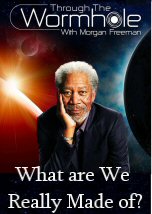
What are We Really Made of

   2011    Science
What is the universe made of? If you answered stars, planets, gas and dust, you'd be dead wrong. Thirty years ago, scientists first realized that some unknown dark substance was affecting the way galaxies moved. Today, they think there must be five times our understanding of the universe and the nature of reality itself has drastically changed over the last 100 years - and it's on the verge of another seismic shift. In a 17-mile-long tunnel buried 570 feet beneath the Franco-Swiss border, the world's largest and most powerful atom smasher, the Large Hadron Collider, is powering up. Its goal is nothing less than recreating the first instants of creation, when the universe was unimaginably hot and long-extinct forms of matter sizzled and cooled into stars, planets, and ultimately, us. These incredibly small and exotic particles hold the keys to the greatest mysteries of the universe. What we find could validate our long-held theories about how the world works and what we are made of -- or, all of our notions about the essence of what is real will fall apart.
Series: Through the Wormhole
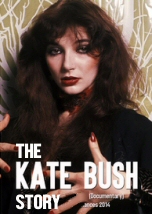
The Kate Bush Story

   2017    History
This documentary explores Kate Bush's career and music, from January 1978's Wuthering Heights to her 2011 album 50 Words for Snow, through the testimony of some of her key collaborators and those she has inspired.
Contributors include the guitarist who discovered her (Pink Floyd's David Gilmour), the choreographer who taught her to dance (Lindsay Kemp) and the musician who she said 'opened her doors' (Peter Gabriel), as well as her engineer and ex-partner (Del Palmer) and several other collaborators (Elton John, Stephen Fry and Nigel Kennedy).
Also exploring their abiding fascination with Kate are fans (John Lydon, Sidi Larbi Cherkaoui) and musicians who have been influenced by her (St Vincent's Annie Clark, Natasha Khan of Bat for Lashes, Tori Amos, Outkast's Big Boi, Guy Garvey and Tricky), as well as writers and comedians who admire her (Jo Brand, Steve Coogan and Neil Gaiman).

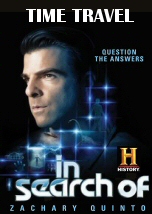
Time Travels

   2018    Science
Zachary Quinto charts a journey to determine whether time travel is possible. He meets a man who claims to have traveled back in time due to a secret government program and a group of people living in Liverpool known as 'time slippers'.
Zachary makes a visit to the CERN headquarters in Geneva, where he attempts to understand the origins of the universe and the dimension of time. Equipped with this new knowledge, Zachary tests his own perception of time with an elaborate skydiving experiment to see if he can slow down time itself.
Series: In Search of

The Mystical North

   2008    Art
Graham-Dixon reveals how the north of the country has produced some of the most dazzling and iconic art of the modern age. Spain's turbulent history has shaped artists from Francisco Goya to Pablo Picasso. Graham-Dixon argues that Spanish architecture is the art form now taking the nation forward in the new millennium.
Series: Art of Spain

Is Everything We Know about the Universe Wrong

   2010    Science
There's something very odd going on in space - something that shouldn't be possible. It is as though vast swathes of the universe are being hoovered up by a vast and unseen celestial vacuum cleaner. Sasha Kaslinsky, the scientist who discovered the phenomenon, is understandably nervous: 'It left us quite unsettled and jittery' he says, 'because this is not something we planned to find'. The accidental discovery of what is ominously being called 'dark flow' not only has implications for the destinies of large numbers of galaxies - it also means that large numbers of scientists might have to find a new way of understanding the universe. Dark flow is the latest in a long line of phenomena that have threatened to rewrite the textbooks. Does it herald a new era of understanding, or does it simply mean that everything we know about the universe is wrong?

How to Collapse a Superpower

   2014    Technology
With a little imagination, could a few terrorists sabotage a mighty nation? Perhaps even tear down modern civilization? The stability of the US, Europe, China, or any global power depends on high-speed digital communication. Our increasing dependence on digital devices and global interactivity may be placing us in grave danger. Scientists around the world are dealing with new threats such as body hacking, Trojan horse viruses, and brain-damaging Internet addiction. But what if the ultimate threat isn’t an attack on technology, but the technology? Could the final superpower be the disembodied mind of the Internet itself?
Series: Through the Wormhole Season 5