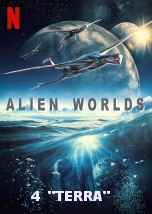
What sort of alien civilizations might exist in the vastness of space? Terra is the fictional world imagined in Episode 4, a planet nine billion years old, twice as old as Earth. Old enough that a truly advanced intelligence could evolve. It was once a fertile world, now it is barren. But life can still thrive here in artificial domes. Over time, they've evolved not to need their bodies. They exist only as neural tissue. They never age, they never die. They're monitored and maintained by robots. If alien civilizations are statistically so likely, why haven't astronomers found any sign of them? Where is everyone? Every time we look at an individual star, that's like dropping a bucket in the ocean. We're going to have to look at a lot of stars and to search through a lot of data until we find the clue that leads us to another civilization.
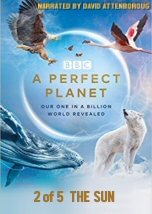
From the frozen poles to the searing deserts, this episode shows how animals have come up with strategies to survive the uneven amounts of sunlight that fall on our planet over the course of a year. The exception is on the equator, where the duration of day and night remain the same throughout the year. Here, this guaranteed sunlight drives the great diversity of life in the tropical jungles.
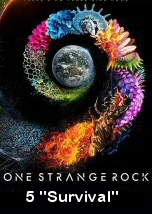
Our strange rock itself can also be lethal. We tend to think of Earth as our life support but it's not there to support us at all. It's a place that's violent, that's beautiful, that's crazy, that's intense. Mother Nature is a serial killer. We wouldn't be here without mass suicide and events so devastating it makes the extinction of the dinosaurs looks like a tea party. There have been 5 mass extinctions on the planet and 99.9 percent of all species that have ever lived are gone. Explore the story of how life on Earth has evolved, becoming lethal for life to thrive.
The Vision After the Sermon, also known as Jacob Wrestling with the Angel, is a painting full of symbolism and mystery. But what does Gauguin’s famous work have to do with a 17-year-old girl called Madeleine, with Victor Hugo’s Les Miserables, and with sumo wrestlers? Waldemar Januszczak reveals all as he investigates Gauguin’s epic religious painting about good and evil, temptation and desire.
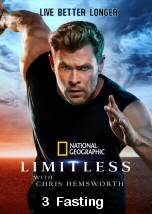
Chris turns to longevity doctor Peter Attia to find out how changing his eating habits can help his quest for longevity. Ironically, the answer is to eat no food at all for four long days. If he can bear the hunger, fasting will unlock his body’s own anti-aging powers and give Chris the edge he needs when he tries to hunt for his next meal … by spearfishing off the Great Barrier Reef.
Brian travels across the US and encounters some astonishing creatures that reveal how the senses evolved. It is a story that takes him through life's journey, from single-celled organisms to sentient beings.
















If alien civilizations are statistically so likely, why haven't astronomers found any sign of them? Where is everyone? Every time we look at an individual star, that's like dropping a bucket in the ocean. We're going to have to look at a lot of stars and to search through a lot of data until we find the clue that leads us to another civilization.