








Last Watched

"CIA"  Sort by

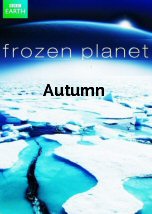
Frozen Planet: Autumn

   2011    Nature
For the animals in the polar regions, autumn means dramatic battles and epic journeys. Time is running out - the Arctic Ocean is freezing over and the sea ice is advancing at 2.5 miles per day around Antarctica. Polar bears gather in large numbers on the Arctic coast as they wait for the return of the ice. Soon, tempers fray and violent sparring contests break out. Meanwhile 2,000 beluga whales head for one special estuary, a gigantic 'whale spa' where they will thrash their snow-white bodies against the gravel and exfoliate. Inland, the tundra undergoes a dramatic transformation from green to fiery red. Here, musk ox males slam head-first into each other with the force of a 30mph car crash as they struggle to defend their harems. Frisky young caribou males play a game of 'grandma's footsteps' as they try to steal the boss's female. Down in Antarctica, Adelie penguin chicks huddle together in creches. When a parent returns from fishing, it leads its twins on a comical steeplechase - sadly there's only enough for one, so the winner gets the meal. Two months later and the chicks are fully feathered apart from downy Mohican hairdos - they're ready to take their first swim - reluctantly though, as it seems penguins are not born with a love of water! And with good reason - a leopard seal explodes from the sea and pulls one from an ice floe, a hunting manoeuvre that has never been filmed before. As winter approaches and everyone has left, the giant emperor penguin arrives and makes an epic trek inland to breed. The mothers soon return to the sea leaving the fathers to hold the eggs and endure the coldest winter on earth.
Series: Frozen Planet
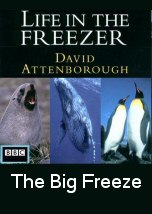
The Big Freeze

   1993    Nature
As almost all animal inhabitants of Antarctica are forced to migrate north, the sea underneath the frozen ice still provides a home to many specially adapted fish whose cells are protected from freezing through an 'antifreeze' liquid. Many of them feed on the faeces of other animals. The most notable larger animal that does not migrate north is perhaps the Weddell Seal, which can be found as close as 1300 kilometres to the pole. Groups of seals tear holes into the ice to dive for food and come up to breathe. The females come back to the ice to give birth. This episode also describes primitive plant life such as lichen, which can still be found on the continent in winter, even in the extremely dry and permanently frozen valleys conditions under which dead animals can lie frozen for many centuries without decomposing. It details the life of the Emperor Penguin, 'the only birds to lay their eggs directly on ice'. While other animals retreat, Emperors migrate not just to the ice, but into the Antarctic continent. The females lay eggs which are incubated by the males under the harshest conditions on Earth (huddling closely together for warmth), while the females return to the sea.
Series: Life in the Freezer

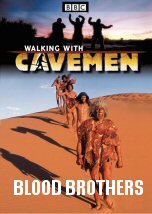
Walking with Cavemen: Blood Brothers

   2003    History
'Blood Brothers' follows the lives of two species, Paranthropus boisei and Homo habilis who embody two alternative ways of ape-man life. Although heavyset, with distinctive gorilla-like faces, the boisei are gentle characters. They live within a strict social structure and are led by a dominant male whose strength and power holds the group together. The habilis have taken a different approach to survival. They don't have the specialisms of the boisei but instead have developed into the archetypal jack-of-all-trades, inquisitive scavengers prepared to try almost anything to survive. Tough, active, gregarious and noisy, they are always on the move and always alert to the possibility of a meal. But in the near drought of the dry season the habilis are struggling. It seems as if their way of life cannot help them when conditions are tough.
Series: Walking with Cavemen

Collapse

   2009    Culture
Michael Ruppert is an independent journalist who has made a minor career out of telling people news that most folks do not want to know. Ruppert, a former police officer, predicted the Wall Street debacle of 2008 several years before the fact, at a time when most analysts were still imagining infinite growth for the stock market and major investment banks. Since then, his vision of the world's future has grown only darker. As Ruppert sees it, civilization and the global economy has yet to wean itself off fossil fuels, and when the world's supply of oil finally runs out, it will lead to a global financial catastrophe that will leave no one unscathed. But while most of what Ruppert has to say bears the ring of truth, there's a small audience for his dire message -- the primary medium for his work is a self-published newsletter, and his most recent book has done so poorly in the marketplace that he faces eviction from his home. Is Ruppert right? And if he is, why doesn't anyone care? Filmmaker Chris Smith profiles Michael Ruppert and gives him a chance to explain his apocalyptic vision of the future at length

Dangerous Knowledge: The Enigma

   2007    Science
brilliant mathematicians whose genius has profoundly affected us, but which tragically drove them insane and eventually led to them all committing suicide. Kurt Gödel, the introverted confidant of Einstein, proved that there would always be problems which were outside human logic. His life ended in a sanatorium where he starved himself to death. Finally, Alan Turing, the great Bletchley Park code breaker, father of computer science and homosexual, died trying to prove that some things are fundamentally unprovable.
Series: Dangerous knowledge

Last Human Standing

   2010    History
xamines the fate of the Neanderthals, our European cousins who died out as modern humans spread from Africa into Europe during the Ice Age. Did modern humans interbreed with Neanderthals or exterminate them? The program explores crucial evidence from the recent decoding of the Neanderthal genome. How did modern humans take over the world? New evidence suggests that they left Africa and colonized the rest of the globe far earlier, and for different reasons, than previously thought. As for Homo sapiens, we have planet Earth to ourselves today, but that's a very recent and unusual situation. For millions of years, many kinds of hominids co-existed. At one time Homo sapiens shared the planet with Neanderthals, Homo erectus, and the mysterious "Hobbits"–three-foot-high humans who thrived on the Indonesian island of Flores until as recently as 12,000 years ago. "Last Human Standing" examines why "we" survived while those other ancestral cousins died out. And it explores the provocative question: In what ways are we still evolving today?
Series: Becoming Human
Atom

Atom

2007  Science
The Sky at Night

The Sky at Night

2018  Science
Tiger

Tiger

2020  History
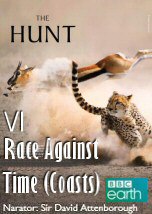
The Hunt

The Hunt

2015  Nature
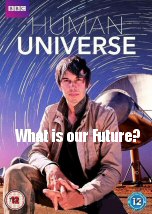
Human universe

Human universe

2014  Technology