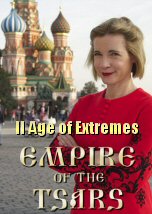
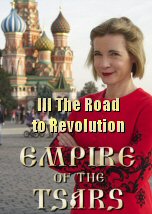
Lucy Worsley continues her journey through Russia in the footsteps of the Romanovs, the most powerful royal dynasty in modern European history. In this episode she examines the extraordinary reign of Catherine the Great, and the traumatic conflict with napoleonic France that provides the setting for the novel War and Peace. At the magnificent palace of Peterhof near St Petersburg, Lucy charts the meteoric rise of Catherine the Great, who seized the Russian throne from her husband Peter III in 1762 and became the most powerful woman in the world. Catherine was a woman of huge passions - for art, for her adopted country (she was German by birth) and for her many lovers. Catherine expanded her empire through military victories overseas, while at home she encouraged education and introduced smallpox inoculation to Russia. But Catherine struggled to introduce deeper reforms, and the institution of serfdom remained largely unchanged. Lucy explains how this injustice fuelled a violent rebellion. Nevertheless, Catherine left Russia more powerful on the world stage than ever. But all she had achieved looked set to be undone when Napoleon invaded Russia in 1812. Lucy relives the pivotal battle of Borodino, when the Russian army finally confronted the French forces; the traumatic destruction of Moscow; and, under Catherine's grandson Alexander, the eventual victory over the French that provided the Romanov dynasty with its most glorious hour.
The years 1825-1918 were bloody and traumatic, a period when four tsars tried - and failed - to deal with the growing pressure for constitutional reform and revolution. In 1861, millions of enslaved serfs were freed by the Tsar-Liberator, Alexander II. But Alexander paid the ultimate penalty for opening the Pandora's box of reform when he was later blown up by terrorists on the streets of St Petersburg. Elsewhere, there was repression, denial, war and - in the case of the last tsar, Nicholas II - a fatalistic belief in the power of God, with Nicholas's faith in the notorious holy man Rasputin being a major part in his undoing. Lucy Worsley also details the chilling murder of Nicholas and his family in 1918, and asks whether all of this horror have been avoided.
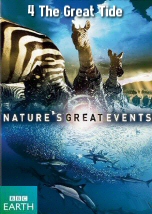
A mighty army of dolphins, sharks, whales, seals and gannets hunt down the billions of sardines along South Africa's east coast each winter. This is the Sardine Run: an underwater Armageddon, the greatest gathering of predators anywhere on the planet, and the most spectacular event in the world's oceans. From intimate moments of the creatures caught up in the run, to the dramatic finale of this spectacular event, The Great Tide is an action-packed feeding-frenzy, filmed underwater, on the ocean's surface, and in the air. However, in recent years the sardine run has become less predictable, perhaps due to the warming effects of climate change. If the sardine run does not happen, the lives of the animals caught up in the drama hang in the balance. Pioneering a unique boat stabilised camera mount for surface filming, Nature's Great Events crew capture all the high octane action as the predators compete for sardines, filmed with aerial, underwater and above water cameras. Super slow motion cameras also capture the very moment gannets plunge into the water, hitting it at sixty miles an hour. A violent winter storm is the trigger for the sardines to begin their desperate dash. They are followed by a super-pod of 5,000 dolphins and further up the coast more predators gather. A shoal of sardines 15 miles long is pushed into the shallows and aerial shots show thousands of sharks gathering to feed on them. The climax to the sardine run is a spectacular feeding frenzy as the dolphins round the sardines up into balls on which all the predators feast. Gannets rain down in their thousands, sharks pile in scattering the fish and a Bryde's whale lunges in taking great mouthfuls of sardines.
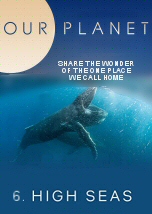
Far from land, where few of us ever venture, is the ocean beyond the boundary of any country. Largely ungoverned, wild, and lawless. Venture into the deep, dark and desolate oceans that are home to an abundance of beautiful - and downright strange - creatures.
Perhaps there is no architectural feature more distinctly Angeleno than a strip mall. The city is full of them with their busy facades and bright neon signage. Their wonderfully eclectic, multi-purpose tenants give shape and home to the multitudes of ethnic communities that make up LA’s diverse population. Trois Mec and Petit Trois can be found side-by-side in a Hollywood strip mall, nestled between a dry cleaners and a Yum Yum donut. Ludo’s restaurants and the dishes he creates for them embody the cultural mash-up and high/low flair that is the strip mall philosophy.
A bistro is typically defined by its modesty – they are relatively small, affordable and humble. The bistro has become rather ubiquitous these days but despite its many incarnations, at its core, a bistro is a place where every man can eat, and eat well. With Petit Trois, Ludo Lefebvre has brought the spirit of the bistro to Los Angeles. In this episode, Ludo brings us back to Paris to introduce us to some of the people and places that first inspired him to begin a culinary career.










Catherine expanded her empire through military victories overseas, while at home she encouraged education and introduced smallpox inoculation to Russia. But Catherine struggled to introduce deeper reforms, and the institution of serfdom remained largely unchanged. Lucy explains how this injustice fuelled a violent rebellion. Nevertheless, Catherine left Russia more powerful on the world stage than ever. But all she had achieved looked set to be undone when Napoleon invaded Russia in 1812. Lucy relives the pivotal battle of Borodino, when the Russian army finally confronted the French forces; the traumatic destruction of Moscow; and, under Catherine's grandson Alexander, the eventual victory over the French that provided the Romanov dynasty with its most glorious hour.