Mathematician Dr Hannah Fry explores the mystery of maths. It underpins so much of our modern world that it's hard to imagine life without its technological advances, but where exactly does maths come from? Is it invented like a language or is it something discovered and part of the fabric of the universe? It's a question that some of the most eminent mathematical minds have been wrestling with. To investigate this question, Hannah goes head first down the fastest zip wire in the world to learn more about Newton's law of gravity, she paraglides to understand where the theory of maths and its practice application collide, and she travels to infinity and beyond to discover that some infinities are bigger than others. In this episode, Hannah goes back to the time of the ancient Greeks to find out why they were so fascinated by the connection between beautiful music and maths. The patterns our ancestors found in music are all around us, from the way a sunflower stores its seeds to the number of petals in a flower. Even the shapes of some of the smallest structures in nature, such as viruses, seem to follow the rules of maths. All strong evidence for maths being discovered. But there are those who claim maths is all in our heads and something we invented. To find out if this is true, Hannah has her brain scanned. It turns out there is a place in all our brains where we do maths, but that doesn't prove its invented. Experiments with infants, who have never had a maths lesson in their lives, suggests we all come hardwired to do maths. Far from being a creation of the human mind, this is evidence for maths being something we discover. Then along comes the invention of zero to help make counting more convenient and the creation of imaginary numbers, and the balance is tilted in the direction of maths being something we invented. The question of whether maths is invented or discovered just got a whole lot more difficult to answer
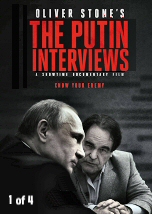
Oscar-winning filmmaker Oliver Stone was granted unprecedented access to Russian president Vladimir Putin during more than a dozen interviews over two years, with no topic off-limits. This remarkable four-part documentary series provides intimate insight into Putin's personal and professional lives, from his childhood under communism, to his rise to power, his relations with four U.S. presidents, and his surprising takes on U.S.-Russian relations today. Witness the most detailed portrait of Putin ever granted to a Western interviewer.
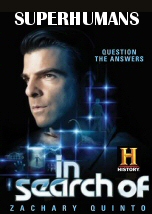
The Series 'In Search of' conducted investigations into the controversial, paranormal and mysterious. The producer's purpose is to suggest some possible explanations, but not necessarily the only ones, to the mysteries examined. The 2018 revival is presented by Zachary Quinto. In this episode, Zach wants to understand how a person can be superhuman. He meets a man who bent the metal frame of a car door with his bare hands in a moment of crisis; a man who can feel no pain; and a Shaolin warrior monk, who teaches him how to harness superhuman powers of his own.
The climate is changing faster than ever, which is why 'fix our climate' is one of the five goals of the Earthshot Prize. Prince William, Sir David Attenborough and Christiana Figueres highlight inspiring and often unexpected solutions to the challenge. In this film, we'll explain the scale of the problem posed by climate change and will introduce you to some amazing people already working on climate crisis. One of these three finalists will win the Earthshot Prize and get the platform and resources they need to scale their ground-breaking work. Nine more solutions for fixing our climate will receive the same support over the course of this decade.
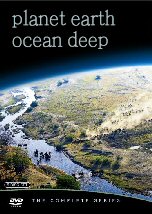
Life goes to extraordinary lengths to survive this immense realm. A 30 tonne whale shark gorges on a school of fish and the unique overhead heli-gimbal camera reveals common dolphins rocketing at more than 30km an hour. Descending into the abyss, deep sea octopus fly with wings and vampire squid use bioluminescence to create an extraordinary colour display. The first ever time-lapse footage taken from 2,000m down captures eels, crabs and giant isopods eating a carcass, completely consuming it within three hours.
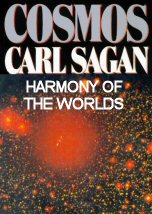
Beginning with the separation of the fuzzy thinking and pious fraud of astrology from the careful observations of astronomy, Sagan follows the development of astronomical observation. Beginning with constellations and ceremonial calendars (such as those of the Anasazi), the story moves to the debate between Earth and Sun-centered models: Ptolemy and the geocentric worldview, Copernicus' theory, the data-gathering of Tycho Brahe, and the achievements of Johannes Kepler (Kepler's laws of planetary motion and the first science-fiction novel).








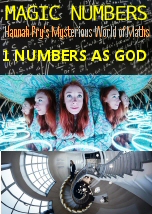




In this episode, Hannah goes back to the time of the ancient Greeks to find out why they were so fascinated by the connection between beautiful music and maths. The patterns our ancestors found in music are all around us, from the way a sunflower stores its seeds to the number of petals in a flower. Even the shapes of some of the smallest structures in nature, such as viruses, seem to follow the rules of maths. All strong evidence for maths being discovered. But there are those who claim maths is all in our heads and something we invented. To find out if this is true, Hannah has her brain scanned. It turns out there is a place in all our brains where we do maths, but that doesn't prove its invented.
Experiments with infants, who have never had a maths lesson in their lives, suggests we all come hardwired to do maths. Far from being a creation of the human mind, this is evidence for maths being something we discover. Then along comes the invention of zero to help make counting more convenient and the creation of imaginary numbers, and the balance is tilted in the direction of maths being something we invented. The question of whether maths is invented or discovered just got a whole lot more difficult to answer