










Last Watched

"Ostrich"  Sort by

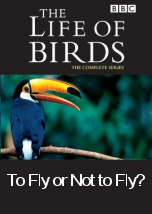
To Fly or Not to Fly

   1998    Nature
The first episode looks at how birds first took to the skies in the wake of the insects. It begins in Mexico, where Sir Attenborough observes bats being outmanoeuvred by a red-tailed hawk. Pterosaurs were the birds' forerunners, some 150 million years after dragonflies developed the means of flight, but eventually went extinct together with the dinosaurs. Birds had by then already evolved from early forms like archaeopteryx, the first creature to possess feathers. Its ancestry can be traced through reptiles, and some current species, such as the flying lizard, possibly show paths this evolution may have taken." One of the biggest birds to have ever existed was the terror bird, which proliferated after dinosaurs vanished and stood up to 2.5 metres tall. By comparison, the ostrich, while not closely related, is the largest and heaviest living bird. It was probably the evasion of predators that drove most birds into the air, so their flightless cousins evolved because they had few enemies. Accordingly, such species are more likely to be found on islands, and Sir Attenborough visits New Zealand to observe its great variety, most especially the kiwi. Also depicted is the moa, another huge creature that is now gone. The takahē is extremely rare, and high in the mountains of New Zealand, Sir Attenborough discovers one from a population of only 40 pairs. Finally, another example on the brink of extinction is the kakapo, which at one point numbered only 61 individuals. A male is heard calling — an immensely amplified deep note that can be heard at great distances from its nest.
Series: The Life of Birds
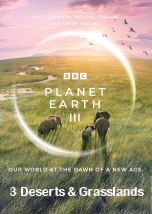
Planet Earth III: Deserts and Grasslands

   2023    Nature
The third episode takes viewers on a riveting journey to some of the world's most extreme and breathtaking deserts and grasslands, where nature puts on its most dramatic show. It begins in the arid landscapes of Central Africa's Guelta d'Archei and the Namib Desert in Southwest Africa, places where water is scarce, and survival is a daily battle. The focus then shifts to the remarkable adaptability of creatures like ostriches, who brave the scorching heat and predators to raise their young and a handful of leopards who learned to hunt from trees on the African plains.
In Australia, viewers witness the intricate courtship rituals of the spotted bowerbird, a species facing challenges due to climate change. The narrative then takes us to the vast Eurasian Steppe, home to the unique Saiga antelope, and to Brazil's Cerrado, a biodiverse grassland where the elusive maned wolf plays a crucial role in maintaining the ecosystem.
The episode highlights not only the resilience and beauty of these creatures but also the fragility of their habitats, emphasizing the urgent need for conservation efforts.
Series: Planet Earth III

Evolution Ep 1-2

   2026    Science    HD
From the first flicker of life billions of years ago to the extraordinary diversity of animals alive today, Chris Packham embarks on an epic journey through evolution. Combining cutting-edge science, spectacular wildlife and vivid reconstructions of long-vanished creatures, he reveals how countless generations of innovation, adaptation and chance transformed simple cells into bodies capable of movement, reproduction, flight, intelligence and astonishing complexity. Along the way, familiar animals become gateways into some of the greatest mysteries in the history of life.
In the first two episodes, Packham traces two remarkable evolutionary stories. In Kenya, he asks how a microscopic cell could ultimately give rise to the enormous, intelligent and highly social elephant, uncovering the crucial breakthroughs that made complex bodies, lungs, limbs and giant size possible. Then, in South Africa, the ostrich and its extraordinary egg open the door to the evolution of reproduction itself: From the origins of sex to the appearance of eggs, feathers and flight. Together, these episodes reveal that some of nature’s most spectacular creatures are the result of billions of years of unlikely experiments, lucky accidents and relentless adaptation.
Series: Evolution
Food Inc

Food Inc

2009  Technology
Space

Space

2001  Science
Seven Ages of Rock

Seven Ages of Rock

2007  Art
Zeitgeist

Zeitgeist

2007  Culture
Universe

Universe

2021  Science
Blue Planet II

Blue Planet II

2017  Nature
Vietnam in HD

Vietnam in HD

2011  History
The Beauty of Maps

The Beauty of Maps

2010  Art