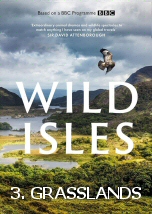





David Attenborough explores Britain and Ireland’s grasslands, revealing the creatures that create them and the extraordinary stories they hide. From the coastal flower meadows in the Scottish Outer Hebrides to the rich open landscapes in the mountains of southern Ireland, we enter surprising and dramatic worlds. In southern England, we meet an extraordinary bee that lives in chalk grassland, one of our rarest habitats, laying her eggs in empty snail shells. Meanwhile, in the colourful machair of the Hebrides, ringed plovers and lapwings strive to rear their families of tiny fluffy chicks and to save them for marauding gulls. We travel back in time to explore the vast wild grasslands once found throughout our isles, before meeting herds of semi-wild horses, where males battle fiercely for the females. Today, they are helping to turn some of this land back to wilderness. And in our precious remaining pockets of flower-rich meadow, a remarkable conservation success story plays out. Once extinct in our isles, England now has the largest known populations of large blue butterflies. Their survival relies on a game of deception with red ants, which are tricked into adopting the butterfly’s unassuming but predatory caterpillars. Our story then journeys to the mountains. Each morning in early spring, feisty male black grouse battle for prime position on their frozen breeding grounds. Their sole mission is to impress a female. Meanwhile, on south-facing scree slopes, dozens of adders emerge from hibernation to perform a surprisingly delicate courtship routine. The episode concludes with a mighty battle in the wild mountains of County Kerry. This is the scene of an epic and spectacular rut between the largest land mammals in Britain and Ireland, red deer. The grasslands of Britain and Ireland are under threat. We have lost 97 per cent of our species-rich meadows in the last century, as modern agriculture replaces these precious habitats. This episode shows just how important different types of grassland are to the species which call these islands home.
Sir David Attenborough explores the surprisingly vibrant seas that surround the British Isles. The vast watery wilderness around us is over three times the size of our land mass, and yet to many, our oceans remain a mystery. Full of colour and teeming with life, the seas of Britain and Ireland are crucially important to a range of wildlife. This episode goes beneath the waves to uncover the thriving habitats that exist along our 22,000-mile coastline. In winter, clear evidence of the ocean’s abundance can be seen on a beach in Norfolk. Thousands of grey seals congregate on the shoreline to give birth. Britain and Ireland are home to 40 per cent of the world’s grey seals, and the number being born on our shore rises every year. Once the newly born pups are weaned, the females are ready to breed again, and heavyweight males enter violent, bloody fights to win a stretch of beach, and the females along with it. Beyond the beach, the vibrant shallows contain several important habitats. Rich beds of seagrass are nurseries for a range of animals, while also acting as very important carbon storage areas. They are also home to one of the strangest fish in our waters, the seahorse. We follow a male and female as they perform a balletic mating dance in the water, delicately entwining their tails. The stakes are high, as these animals mate for life. In a touching piece to camera, Sir David bids a fledging Manx shearwater chick farewell as it embarks on a 6,000-mile journey across the oceans to South America. There is no better example of how important the British Isles and its abundant seas are to the survival of wildlife worldwide.
Two lifelong friends set out on an unforgettable journey across Europe like you've never seen before — not on modern machines, but on beautifully restored vintage motorbikes. From the rugged beauty of the Scottish Highlands to the icy reaches of the Arctic Circle, and down through the heart of the Baltics and continental Europe, they follow an unconventional path fueled by curiosity, friendship, and a passion for the open road. As they ride thousands of miles over two months, every detour reveals a new story, every breakdown sparks laughter, and every mile deepens their bond. This isn’t just a road trip — it’s a soulful ride through landscapes, memories, and the timeless joy of adventure. The first three episodes of this standout series follow Ewan and Charley as they set off across Europe — taking the longest, most adventurous way possible. After crossing the North Sea, they ride through the Netherlands and Germany, stopping in Charley’s mother’s hometown before continuing toward the Danish islands, where the sense of freedom begins to take hold. But the road soon turns unpredictable. In Sweden, Ewan’s bike breaks down, stranding him in unfamiliar territory. A group of local bikers steps in to help, showing that the journey is not just about distance, but about the people you meet along the way. With their support, he reaches iconic Scandinavian landmarks and new challenges, realizing that this ride is as much about resilience and friendship as it is about travel. These early episodes promise more than adventure — they deliver a soulful, cinematic ride into the heart of connection and discovery.
This visionary documentary series asks a bold and urgent question: how can the power of nature itself help repair the damage we have done to the planet and even reverse climate change? Drawing on cutting-edge science and filmed across some of Earth’s most vital ecosystems, the series reveals nature not as a victim, but as one of our strongest allies. It offers a hopeful glimpse into a future where working with natural systems could restore balance, resilience, and abundance on a global scale. In the first two episodes, the focus turns to oceans and grasslands, two of the planet’s most powerful yet underestimated climate regulators. Viewers discover how marine life plays a crucial role in removing carbon from the atmosphere, and how vast grasslands, sustained by thriving animal populations, lock away carbon beneath the surface. Through new research and striking imagery, the episodes show why protecting and restoring these ecosystems is essential to our future—and how human action can help them recover.
This powerful documentary examines the origins, ideology and evolution of one of the most feared organizations of Nazi Germany. It explores how the SS (Schutzstaffel) transformed from a small protective unit into a vast and ruthless machine that played a central role in the Holocaust. Through detailed analysis and historical evidence, it reveals the distorted beliefs, calculated strategies and systematic brutality that defined its actions, offering a chilling insight into how ordinary structures were turned into instruments of terror on an unprecedented scale. In the first three episodes, the focus turns to the rise of the SS and the individuals who helped shape its power. It traces how recruits were selected and why the organization appealed to certain men, uncovering the mindset behind their commitment. The story delves into the figure of Heinrich Himmler, an unlikely leader whose vision and ambition drove the expansion of the SS, as well as Reinhard Heydrich, whose cold and methodical approach made him one of the key architects of the Holocaust. Together, these episodes reveal how leadership, ideology and personal ambition combined to fuel one of history’s darkest forces.
In southern England, we meet an extraordinary bee that lives in chalk grassland, one of our rarest habitats, laying her eggs in empty snail shells. Meanwhile, in the colourful machair of the Hebrides, ringed plovers and lapwings strive to rear their families of tiny fluffy chicks and to save them for marauding gulls.
We travel back in time to explore the vast wild grasslands once found throughout our isles, before meeting herds of semi-wild horses, where males battle fiercely for the females. Today, they are helping to turn some of this land back to wilderness. And in our precious remaining pockets of flower-rich meadow, a remarkable conservation success story plays out. Once extinct in our isles, England now has the largest known populations of large blue butterflies. Their survival relies on a game of deception with red ants, which are tricked into adopting the butterfly’s unassuming but predatory caterpillars.
Our story then journeys to the mountains. Each morning in early spring, feisty male black grouse battle for prime position on their frozen breeding grounds. Their sole mission is to impress a female. Meanwhile, on south-facing scree slopes, dozens of adders emerge from hibernation to perform a surprisingly delicate courtship routine.
The episode concludes with a mighty battle in the wild mountains of County Kerry. This is the scene of an epic and spectacular rut between the largest land mammals in Britain and Ireland, red deer.
The grasslands of Britain and Ireland are under threat. We have lost 97 per cent of our species-rich meadows in the last century, as modern agriculture replaces these precious habitats. This episode shows just how important different types of grassland are to the species which call these islands home.