







Last Watched

"Environment"  Sort by

The Death of the Oceans

   2010    Nature
Sir David Attenborough reveals the findings of one of the most ambitious scientific studies of our time - an investigation into what is happening to our oceans. He looks at whether it is too late to save their remarkable biodiversity. Attenborough explores some of the ways in which we are affecting marine life - from over-fishing to the acidification of sea water. The film also uncovers the disturbing story of how shipping noise is deafening whales and dolphins, affecting their survival in the future.

Living with Predators. Conservation

   2015    Nature
The final episode of the series visits the frontline of the conflict with the world's top predators, meeting the scientists fighting to save them. Crossing five continents and combining landmark natural history footage with real-life human drama, it checks the pulse of the earth's iconic animals, including lions, tigers, polar bears and blue whales. With three-quarters of the planet's carnivores now in decline, can people find ways to live with predators before they disappear forever?
Series: The Hunt

Surviving

   1995    Nature
the final episode deals with plants that live in hostile environments. Attenborough visits Ellesmere Island, north of the Arctic Circle, to demonstrate that even in a place that is unconducive to life, it can be found. Algae and lichens grow in or on rock, and during summer, when the ice melts, flowers are much more apparent. However, they must remain close to the ground to stay out of the chilling wind. In the Tasmanian mountains, plants conserve heat by growing into 'cushions' that act as solar panels, with as many as a million individual shoots grouped together as one. Others, such as the lobelia in Mount Kenya, have a 'fur coat' of dense hairs on their leaves. The saguaro cactus in the Sonoran Desert flourishes because of its ability to retain vast amounts of water, which can't be lost through leaves because it has none. Many desert dwellers benefit from an accelerated life cycle, blooming rapidly within weeks after rainfall. Conversely, Mount Roraima is one of the wettest places on Earth. It is a huge sandstone plateau with high waterfalls and nutrients are continuously washed away, so plants have to adapt their diet if they are to survive. A bladderwort is shown invading a bromeliad. Inhabitants of lakes have other problems to contend with: those that dominate the surface will proliferate, and the Amazon water lily provides an apt illustration. Attenborough ends the series with an entreaty for the conservation of plant species.
Series: The Private Life of Plants

Grand Canyon Adventure

   2008    Nature    3D    HD
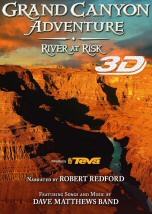
Anthropologist Wade Davis and river advocate Robert F. Kennedy Jr journey down the Colorado River on a two-week expedition to highlight water conservation issues. Traveling by rafts, kayaks and wooden dories, they are accompanied by their daughters and guided by Shana Watahomigie, a Native American National Park ranger. Filmed with a 350-pound 3D camera, it involved the cooperation of three Indian nations, the National Park Service, film sponsor Teva’s team of kayakers and more than a dozen experienced river guides. The film explores America's drought and freshwater shortages, the impact on the river of damming, and human water supply needs. Grand Canyon Adventure: River at Risk was directed by Greg MacGillivray and narrated by Robert Redford.

Fukushima Is Nuclear Power Safe

   2011    Technology
Professor Jim Al-Khalili sets out to discover whether nuclear power is safe. He begins in Japan, at the former Fukushima nuclear plant, where he meets some of the tens of thousands of people who have been evacuated from the exclusion zone. He travels to an abandoned village just outside the zone to witness a nuclear clean-up operation. Jim draws on the latest scientific findings from Japan and from the previous explosion at Chernobyl to understand how dangerous the release of radiation is likely to be and what that means for our trust in nuclear power.

The Stone at the Centre

   2013    History
Deep in the Bolivian Andes at the height of 13,000ft stands Tiwanaku, the awe-inspiring ruins of a monolithic temple city. Built by a civilisation who dominated a vast swathe of South America, it was abandoned 1,000 years ago. For centuries it has been a mystery - how did a civilisation flourish at such an altitude and why did it vanish? Jago Cooper journeys through Bolivia's spectacular landscape to investigate the origins of Tiwanaku and finds evidence of an ancient people with amazing understanding of their environment, whose religion was based on collective effort and ritual beer drinking.
Series: Lost Kingdoms of South America
Leaving Neverland

Leaving Neverland

2019  Culture
The Rehearsal

The Rehearsal

2022  Culture
Top Gear

Top Gear

2012  Technology
Hiroshima

Hiroshima

2005  History
Wild South America

Wild South America

2005  Nature