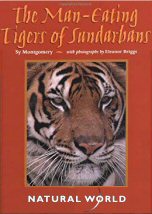
The Sundarbans mangrove forest, in Bangladesh near the Indian border, is a tidal jungle where Ganges and Brahmaputra enter the Indian Ocean. Its has some 400 Bengal tigers - the largest population in the world, and the only to be hardly scared of men. The downside is tigers kill up the 50 Bangladeshis a year, even from neighbouring villages, so keeping them inside the reserve is key to long-term survival. A recent project tries to train local mongrels, not pets but fiercely self-reliant dogs, to spot and even scare off tigers from villages. An individual tiger can turn into a man-eater in order to survive - this process may occur due to an injury or old age (and so cannot hunt agile prey) or even accidentally tasting human flesh.
Half of the population in Western society suffers from being overweight. Cardio-vascular diseases, diabetes and cancer are epidemic. Our meat consumption has quintupled over the past 50 years. 65 billion land animals are being slaughtered every year for food consumption. One third of the global grain production is fed to animals for fattening while 1.8 billion people worldwide suffer from hunger and starvation. Can there really be a solution to all these problems? H.O.P.E. is a life-changing documentary uncovering and revealing the effects of our typical Western diet high in animal-based foods. It contrasts the limited interests of the pharmaceutical and agricultural industry with the all-encompassing interests of living beings on this planet and with the power of responsible consumer action. H.O.P.E. is an urgent call to action to all of us to commit to a change towards sustainability and safeguarding our living environment.
Grasslands feed the world. Over thousands of years, we humans have learned to grow grains on the grasslands and domesticate the creatures that live there. Our success has propelled our population to almost seven billion people. But this episode reveals that, even today, life in the 'Garden of Eden' isn't always rosy. We walk with the Dorobo people of Kenya as they bravely attempt to scare off a pride of hungry lions from their freshly caught kill. We gallop across the Steppe with extraordinary Mongolian horsemen who were 'born in the saddle'. And in a perfect partnership with nature built up over generations Maasai children must literally talk to the birds! The honeyguide leads them to find sweet treats, but they'll have to repay the favour.
Just about every solid, liquid, or gas in the world as we know it begins with reactions between individual atoms and molecules. Host David Pogue dives into the transformative world of chemical reactions, from the complex formula that produces cement to the single reaction that’s allowed farmers to feed a global population by the billions.
Twenty years on from the invention of the world wide web, this major new series takes stock of its profound impact – how, for better and for worse, the digital revolution is reshaping our lives. Dr Aleks Krotoski explores the meaning of a phenomenon that is transforming everything, from how we learn to how we shop, vote and make friends. With a quarter of the planet connected so far, this series examines what is in store for the remaining 75 per cent of the world's population as they come online." In the first part series, Aleks charts the extraordinary rise of blogs, Wikipedia and YouTube, and traces an ongoing clash between the freedom the technology offers us, and our innate human desire to control and profit. Dr Aleks Krotoski looks at how it is reshaping almost every aspect of our lives. Joined by some of the web's biggest names - including the founders of Facebook, Twitter, Amazon, Apple and Microsoft, and the web's inventor - she explores how far the web has lived up to its early promise.
In the second episode, the directors learn their vision for the films is not always permissible by the U.S. government. Wyler is shocked by the racism he encounters against African American soldiers and refused to make a film recruiting black soldiers. Meanwhile, the films' racist depiction of the Japanese versus human depiction of the Germans causes worry for the War Department, which at that time planned to redistribute the Japanese-American population from internment camps into towns across the United States.
























A recent project tries to train local mongrels, not pets but fiercely self-reliant dogs, to spot and even scare off tigers from villages. An individual tiger can turn into a man-eater in order to survive - this process may occur due to an injury or old age (and so cannot hunt agile prey) or even accidentally tasting human flesh.